
Ein Gedi Botanic Garden

Ein Gedi Botanic Garden
Seek the serenity of a Judean Desert sky in Autumn at the Ein Gedi Botanic Garden

Saturday, October 29, 2005


These are canary dates. When they are big and ripe, they are sweet as sugar. When they are small and unripe, they are beautiful but... Posted by Picasa

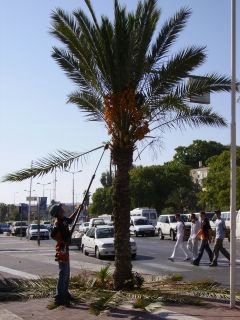
Trimming a canary date palm. Posted by Picasa

The Right Date

It’s that time of year again, when the southern Israeli city of Arad pulls out the cherry picker and makes the rounds of the palm trees.

There are more than 150 of them in this small Negev town (palm trees, not cherry pickers) and nearly all bear fruit each fall, just in time for Sukkot. Veteran residents in Arad know that the Hebrew month of Tishrei brings four different kinds of fresh dates and palm branch cuttings for the sukkot that dot the city.

Jews from every walk of life gather around the crews as they move from one palm to the next as they begin pruning in preparation for the winter months.

The fruit is free if you can catch the town crews while they work. The sweet fruit that Maimonides praised for its efficacy as a digestive aid (take two after your meal once a day) grows in huge bunches.

Palm branches, on the other hand, are for sale. It is best to wait until the crews have trimmed them for you before grabbing, because there are huge, sharp spikes at the base of the stem. The spikes carry a mild poison which causes swelling and irritation if you get stuck.
For 60 NIS (about $15.00 US) in Arad you can buy 10 palm branches, each approximately six feet long and three feet wide, enough to cover a modest sukkah. The crews carefully tie the bundled branches together for your convenience.

Of course, if you happen to know Suleiman Anami, it helps. Then you can get your schach for free. Suleiman, a Bedouin who lives in a small nearby village, is the Gardening Manager for the Parks and Landscaping Department in Arad. His - and actually, that of other people in his department - is the story of successful co-existence.

In 1989, as young 17 year old he found a job working with the landscaping department, doing general maintenance. He worked hard, was loyal and never slacked off. “If you take a job, you do it right,” he told me. “I love my work.” One wife and seven children later (including a pair of two-year old twins), Suleiman has now worked his way up to manager.

“Arad is one of the most beautiful cities in Israel,” he said with obvious pride. “I supervise 200 dunams of land here, all of it planted with flowers, shrubs and trees that can take your breath away, just from the color alone.” It took more than 350 hours to plan and plant the landscaping around the municipal swimming pool. Suleiman carries special certification in botanical fumigation as well. He said it takes an entire month to make one full maintenance round of Arad. That round keeps four of his workers and an irrigation specialist very busy.

The tall date palms, of course, are his special pride and joy, marching along each main road. “I remember when we planted them,” he said. “We had to sink them three or feet into the ground.”

It was Suleiman who told David Avraham to find an especially beautiful bunch of palm branches for us, and who also made sure we also got several huge bunches of fresh red and yellow dates to take home for the holiday.

David’s story is another jewel in the mosaic that is Arad, a special one in the Jewish world. He runs the cherry picker. David is another long-time worker for the department, the only person allowed to rise to the top of the 15-foot palms to trim the branches and gather the dates a difficult skill which he excels at.

A 20-year veteran of the department, David is proud of his responsibility to the city residents, but even prouder of his Ethiopian Jewish heritage. He remembers the 2 ½ year trek by foot across the Sudan as he and his wife made their way toward the site where they would finally be airlifted to the Promised Land.

David is now 58 years old, but he recounted the story of that 1983 journey as if it were yesterday. “We came from the village of Tikraii, near Adyavo,” he said. “Funny, how that village bore the name which in Hebrew means ‘he will yet come’…… I wonder if the village founders ever realized it.” He was already 36 years old when he made that journey, and he came straight to Arad when he got off the plane. A scant two years later, he took the job he has had ever since. “Come to our sukkah,” he invited. “I will tell you my story.”

“Put those dates in the freezer for about a week,” Suleiman advised, “and you will have the sweetest fruit G-d can provide”. David nodded sagely in agreement. “The red ones are the most flavorful,” he added. They are also the heaviest, with an average bunch of fresh red dates weighing in at about 20 lb or more. A natural weight training program, free of charge.

For Aradian date lovers, of course, they are worth their weight in gold.
Sunday, September 18, 2005

A Russian-American Coalition

It's almost 11:00 pm and for once, I am not wondering where my children are.
I am wondering where I am instead, as a returning American immigrant and as a Jew.

The post-Disengagement horror stories continue their steady march into our bruised landscape and those who care are simply numb. Those who did not care before, care even less by now, unmoved by the daily tales of tragedy after tragedy.

Three suicides committed by young soldiers at last count, with scores more admitted to psychiatric wards around the country, unable to cope with the trauma, the grief and the rage of having to perpetrate one of the worst military operations in Israel's history.

Homeless families of seven who used to live in five-bedroom houses are now scattered all over Israel, crammed into two-room apartments the size of their former kitchens. Residents of the much-touted "caravillas" are struggling with burst pipes, inadequate electrical wiring and a faulty infrastructure barely constructed for the thousands expelled from homes the government urged them to build decades ago.

And it's not even winter yet.

We once innocently referred to this place as The Holy Land. We know now that although this will forever be true, it doesn't mean the inhabitants have lived up to the same standards. We have indeed become "a nation like all other nations", to our eternal disgrace.

Filthy Israeli politics has sold us out – again. I wonder how many years it will take until the ethical among us learn that the only way to change the system is to shake off the disillusionment and depression and GET INVOLVED. It means teaching our children, as our predecessors did in the Sixties, that political activism – not only on the streets, but at political events and in actual political parties – is the most effective way to create a new reality.

Our generation has been too reluctant to get our hands dirty with politics, and we are now reaping that bitter harvest. It is not too late, however, to teach our children to be passionate about a commitment to politics as a venue for changing a corrupt and broken system. This country desperately needs it. We desperately need it.

The Russians, for once, are way ahead of us and wisely started their own political party years ago to protect their own interests and those they perceived to be Israel's.

It's time to form a North American immigrant party to bring this country back to the ethical Jewish standards we thought we were "moving up to" when we made aliyah.

And since some of our concerns are identical to those in Natan Sharansky's party (immigrant rights, for example) perhaps we could form a coalition together – who says miracles don't happen?

In the Middle East, even the Russians and Americans can team up for the same cause.

Thursday, August 11, 2005

Social Workers and The Disengagement

My colleague at a therapeutic girls' dormitory, a social worker, has spent the last six months in and out of Gush Katif every week, bringing hope and support and supplies to those who built their homes in support of the religious zionist dream. She is deeply worried about what is happening to the families there as they face the final scenes of this mammoth nightmare, but even more concerned about "the day after". Her husband, who was at Yamit "back then", has told her that he cannot go with her to be with the families for the Shabbat prior to Tisha B'Av -- he "just can't face it again". Her children volunteer in the yishuvim wherever they are needed. She has been active in the movement to educate the Israeli public and raise awareness of the depth of what is happening and it has unnerved her.

"I gave out orange strips of cloth on the streets in Tel Aviv," she said, "and people were yelling at me from their cars. 'Go home to your yishuv!' they shouted. 'Go away! Leave us alone already! You people are destroying the country and making a lot of noise out of this issue. Get over it," they yelled. And then they were those who waved, and smiled, and turned their hands thumbs up while driving, who said 'Yasher koach!' and 'Keep the faith!' -- and it is just exhausting to live through it all." And that was only one day's activity, between the days she puts in helping frum teenage girls repair their broken lives after living with neglect and abuse in their homes.

Yes, we have that too here in the Holy Land, to my infinite sorrow.

Meanwhile, the directory of our dormitory, an outstanding senior clinical social worker, has a
mother and two brothers and their families who live in "the Gush". His mother is almost packed and he is planning to help her move; she is too old to deal with the stress of the coming days. His brothers are having bigger problems. They pack their things, knowing they can only fight so far. Their wives unpack every box, every day, as soon as the men have closed them. They refuse to leave their homes, to dismantle their lives for the political pleasure of others.

"Marriages are in trouble," he tells me. "Husbands and wives are arguing and crying and fighting with each other all through the yishuvim. These are some of the unspoken things that escape the notice of the media and the friends, for husbands and wives rarely air their dirty laundry in public, let alone convey their most intimate wounds resulting from this trauma. When I left work, my boss was planning to go to the Gush to help his family and was "unclear about how or when" he would return.

"My brother is selling all his furniture," he said. "There is nowhere to store it, not for the length of time it will take to rebuild his home elsewhere. He has to move into a caravan the government says it will provide -- and there are not enough of them -- and they are barely a quarter of the size of his home. His beautiful garden, which he spent so many hours and days and years tending, is a huge sacrifice for his children on the altar of this government's stupidity. And their promises are lies: the caravans are not yet ready, the new locations for the communities are not even chosen yet. The land is not prepared, the plots are not set, the community infrastructure is years away, as are the basic amenities providing services to their homes, such as piping for water, electricity, gas and phones. And once those things are done, it will still take months -- and possibly years -- until the homes themselves are built. By that time, storage fees will have cost more than the new home will be worth."

Some 10,000 people will be homeless by Elul, evicted by the government of Israel, their mothers and children traumatized along with husbands and fathers, brothers and sisters, parents, cousins, friends and soldiers who are forced to do the bidding of their commanders, who are equally distressed about their roles in this tragedy.

Then there are the social workers. We, as clinical and community professionals, are struggling with the trauma as well -- primary and secondary. We are traumatized by what we witness, what we read, what we hear and what we experience. We are traumatized by the trauma of our clients. We are trapped by our own deep and frightening knowledge of what we know is already happening and what yet awaits everyone. We are traumatized by events totally beyond our control, events that leave us with no option other than to set aside our own feelings and minister to others, to all of our brethren, and to watch the systematic destruction of their lives and the generations to follow, those children and grandchildren to whom the victims trauma will be passed on.

This is not the Holocaust. Jews are not being murdered by strangers, or even by our own. That is true. But in a real way it is having a similar effect on many of the families suffering through the annihilation of everything they have built, some for the second time after a relocation to Gaza from Yamit, the scene of another exile from their homes. The promise of a new life, building the Land and securing our borders to protect our People, has become a nightmare of unparallelled dimension.

We, the social workers of Israel, will be there to support and succor them, during the disaster and in the days after, in the years and decades to follow. That is our mandate: to comfort, to help rebuild, to offer and coordinate support and social services, to teach victims how to move on and reclaim their lives. That is what social workers do. "

But for us, we who must find a way to accomplish this task while setting aside our own grief and rage at the injustice and tragedy of it all, it is a trauma upon trauma, our own and that of all the others which we must bear.

I hereby honor all of my colleagues who have donated their time, their strength and their faith to this task, and who willingly face their own feelings while helping others to face and deal with their own. I honor their husbands and children and families, who bear the brunt of their silent pain, and not-so-silent suffering when it burst far from the eyes of their clients and the cameras.
May G-d grant us all strength in these coming days of insanity and may we someday merit to see the sense of it all, though it is hidden from us now. May our pain be the final birth pang that brings the coming of Moshiach Tzidkenu so this horrendous Diaspora may end once and for all. May G-d have mercy on all of us.

Sunday, July 10, 2005

The Bus Driver

The Egged bus from Beersheva to Arad is always packed and yesterday was no exception.
Young soldiers and hotshot teens from the Air Force Tech High School jostle the paying customers pushing their way ahead of everyone to grab seats where they can drift off to sleep on their way home from the bases in the Negev. Old Russian ladies grumble loudly and occasionally shove others aside, indignant that anyone would venture ahead of them. Dark-eyed Bedouin women, their faces framed by beautiful scarves, wait patiently till the others find their places, sometimes holding babies, sometimes gently holding an older child's hand; they never, ever scrabble or fight to find a place the way so many others do. So many different kinds of people packed into one coach-sized bus hand their money or their bus tickets to the driver as they move along. The driver was working as fast as he could to keep the traffic flowing smoothly -- until I climbed aboard.
As usual, I handed him my bus pass with a greeting. He smiled in reply, but did not let go of my ticket. There we were, connected by the small card, trapped together in the front of the bus. I had no idea why and he wasn't talking. I tugged. He held on. Perplexed, I tugged again. Preoccupied, he simply didn't let go.
"What's up?" I inquired. It didn't make sense.
He glanced at a young girl sitting in the front seat. "She doesn't have the money for the fare."
She colored. "I said I will bring it to you later. You know I am good for it."
He shook his head and looked straight at me. "She can't pay for the fare. You have a ticket."
Oh, right. I got it. "So what's the big deal? Just take it out of mine. " It didn't bother me.
"We'll split it," he corrected me. "Half from you and half from me. You pay with your ticket and I will give you change." He smiled. I smiled.
"No no no no NO!!!" the girl wailed. "I can PAY it, I said!! I will bring it to you tonight!"
Meanwhile, the driver punched my ticket and got the bus on the road. I sat next to her. "You don't understand," I said soothingly. "I have a discounted ticket, with two free rides anyway. I didn't pay anything. It was one of the freebies." The driver nodded his approval.
"If you are really worried about it, we can split it three ways, okay? He'll pay 5 shekels, I pay 5 shekels and you can put 5 shekels in the pushka when you get home."
She didn't like this compromise either, but at the end she was outvoted and finally gave up. The driver grinned at me. I grinned back. Anyway it comes out of the kitty," he added. "Big deal."
The girl moved to the back, murmuring her thanks and insistence that she would pay him back. He laughed. "Put it in the pushka," he told her.
I nodded my approval. That's what a Jewish State is all about.